Cognitive warfare and information security – Interview with Maja Slaveva, one of the winners of the Science communication competition
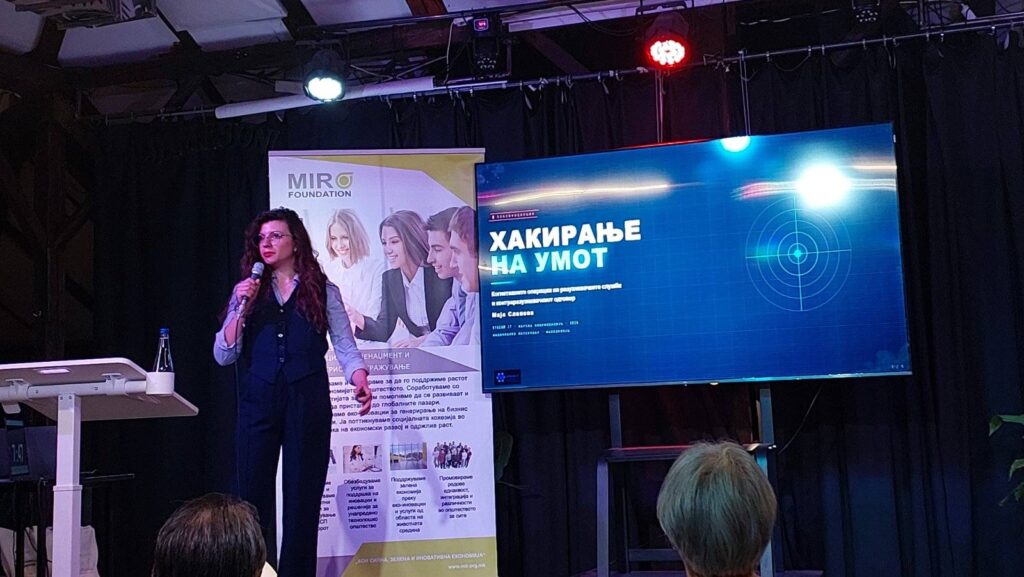
As part of the STREAM IT Mentoring Programme for science communication, a national competition was organised where young researchers had the opportunity to present their scientific ideas to a wider audience. We spoke with Maja Slaveva from the “St. Kliment Ohridski” University – Bitola; Faculty of Security – Skopje, who won second place with the presentation “Hacking the mind – Cognitive operations of intelligence services and the counterintelligence response.”
To begin with, could you tell us a little more about yourself – what did you study, and what inspired you to choose this field?
I am Maja Slaveva – a PhD candidate at the Faculty of Security in Skopje, at the “St. Kliment Ohridski” University. I graduated from the Faculty of Public Administration in Bitola, and I also hold a master’s degree in Strategic Communications Management, where I researched international influence on public opinion regarding the 2018 referendum in Macedonia – one of the most controversial political moments in our recent history. From the very beginning of my higher education, I started focusing on the study of state systems, management, social systems, international relations, diplomacy, and, in my opinion, the peak of all of this is security studies, meaning national security. I look at the bigger picture: I am not interested only in propaganda or diplomacy – I am interested in the mechanism through which information changes people from within, without them even being aware of it. That is precisely why, at the national competition, I worked on the topic “Hacking the mind – Cognitive operations of intelligence services and the counterintelligence response.”Intelligence and counterintelligence are topics that always attract great public interest, but they are almost always viewed “from the outside,” with a mixture of fascination and conspiratorial thinking.
What motivated you to apply for the mentoring programme, and what expectations did you have when you joined?
I am a person who participates in international and national schools, and my non-formal education is broad and extensive. Whenever I see an opportunity for personal growth, but also when I see that I can contribute with my influence, I apply to open calls. When I saw the STREAM IT programme, it was a challenge for me to participate in a national competition with selected young scientists. I wanted to “translate” academic work into a language accessible to the wider public, especially when it comes to my topic. During my doctoral studies, I have often found myself researching topics that are deeply relevant to every citizen, but of which the ordinary person is not aware. On the other hand, I consider public speaking and presenting to be one of my strengths, and I enjoy speaking in front of an audience. There is a certain magic in managing to turn the audience’s attention toward you and make them listen and become interested in something they either do not know or were not interested in before. In this case, science communication is not just a technique – it is a responsibility. A responsibility to give the audience tools for critical thinking, not just information for passive acceptance. And when the topic is cognitive warfare, when you are literally talking about the mind as a battlefield, that responsibility becomes even greater.
How did the idea for the topic you presented at the competition come about, and what was the research and preparation process like?
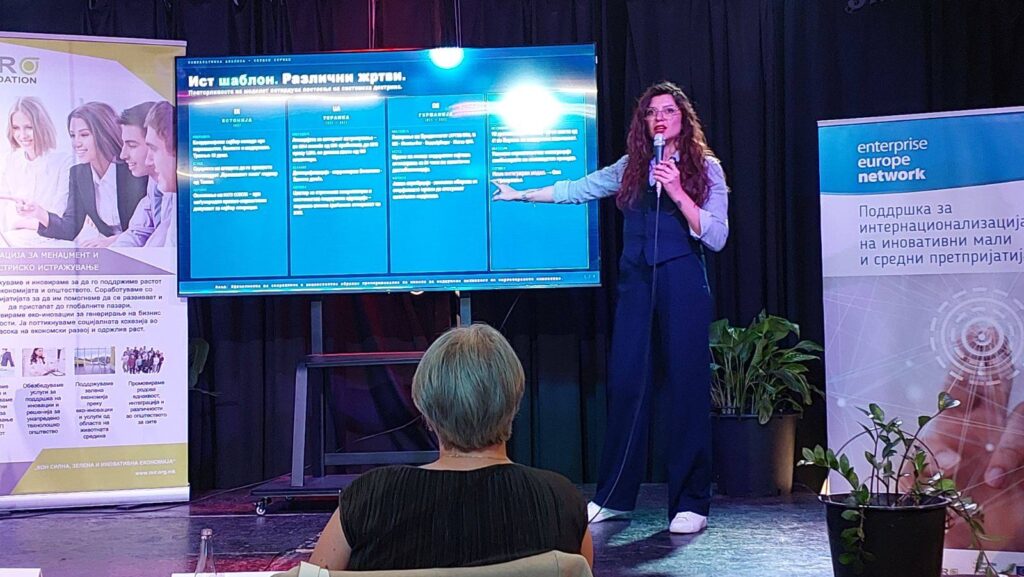
The topic “Hacking the mind – Cognitive operations of intelligence services and the counterintelligence response.” was not born by chance – as I mentioned earlier. In my research on the 2018 referendum, I documented 113 official visits by international representatives in only three months before the vote. A survey of 464 Macedonian citizens showed that 88.8% perceived foreign interference, but also that 83.4% spontaneously resisted it. That is when I formulated the true scientific thesis: this is not a Macedonian phenomenon, but a global institutionalized doctrine. Therefore, the research became comparative – four case studies: Estonia (2007), Ukraine (2014-2022), Germany (2015-2025), and Macedonia. In all four cases, I found the same four-phase operational model: production of a narrative, dissemination through algorithms and bots, amplification through local agents according to the MICE model – Money, Ideology, Coercion, Ego – and the final effect: not conquest, but polarization. Democratic states do not fall when someone conquers them – they fall when they are “abandoned,” meaning when citizens’ trust in institutions no longer exists. This research proved that these are not isolated incidents, but a system. However, the research did not stop at diagnosis – we also arrived at concrete solutions and recommendations, where I proposed a Model for Cognitive Sovereignty – the first integrated counterintelligence framework for the Western Balkans. I will speak more about this after the research is officially published.
What is important here is that the recommendations are directed at three levels – institutional, media, and civic. The point is that cognitive immunity must be built before an attack, not after it.
What was the biggest challenge during the preparation process, and how much did the mentoring support help you overcome it?
The biggest challenge was not the content – it was already there, in years of research, in the numbers, in the notes. The challenge was to structure it in a way that would be understandable to someone who had never heard of cognitive warfare, while at the same time not losing scientific validity and precision. Our mentor, Prof. Dr. Vesna Rafajlovska, played a key role in this. With great expertise and dedication, she helped us find exactly that balance. This fine balance between academic depth and public accessibility is not something that is simply learned, and I am deeply grateful for her guidance. As a mentoring group, we did not see each other as competition, but as young researchers where each person, with their knowledge and experience, complemented the team. We talked, criticized, shared resources and ideas, and everyone learned something valuable from one another. The fact that two winners – second and third place – came from one mentoring group speaks both to the quality of the mentorship and to the strength of that collaborative spirit.
Was there any piece of advice, feedback, or moment from the mentoring process that particularly stayed with you?
There was one moment that stayed deeply engraved in my memory, and I want to share it with the audience reading this. During one revision, Prof. Dr. Rafajlovska told us: “You know more than anyone else in the audience.”
A simple sentence, but so powerful that it could give anyone the confidence to speak without fear.
How did this experience influence your plans for future academic and professional development?
The topic of cognitive warfare is not only academically relevant, it is also politically current at the European and NATO level, and institutions working on disinformation and hybrid threats are actively looking for exactly these kinds of profiles.
The research also showed that there is enormous social impact and real potential for practical application – in education, in policy, and in institutional response. I am continuing with my work and research, it is important to me to complete my doctorate, and in the future I hope to cooperate with institutions.
What was the most interesting thing you learned about how science can be brought closer to the wider public?
That there is no such thing as “the wider public” – there are specific people with specific fears and everyday experiences. Once I kept them in mind, everything became simpler. Science should not be simplified – it should be humanized. The difference is huge: simplification means losing precision, while humanization means finding the right entry point into the mind of the person you are speaking to. And when the topic is cognitive warfare, when you show people that their reaction to certain content has been predicted and planned in advance, there is no passive audience. Everyone is personally affected. The Macedonian citizen in 2018 did this instinctively – 83% resisted without any systematic mechanism behind them, and the referendum was declared unsuccessful. Imagine how much greater that resilience would be if it were supported by education, institutional support, and a system. Informed and educated citizens with the power of judgment are the first line of cognitive defense, and that is the message that needs to reach everyone.
What would you say to young people who are unsure whether to apply for programmes like this and step outside their comfort zone?
Apply – and not only because of the competition, but because of what you gain along the way. I entered with a clear topic and with the desire to stand before an audience – that was never a challenge for me; on the contrary, I was looking forward to it. But what I did not expect was the depth of the support, both mentoring and collegial. Prof. Dr. Rafajlovska was not just a formal mentor to us – she was a truly invested interlocutor who followed the ideas, encouraged them, and gave them shape. And with the fellow scientists with whom we shared the mentoring group, we built something rare – true academic cooperation without a competitive spirit, only with the desire for everyone to give their best. That is not something learned from textbooks. From experiences like this, you do not leave only with an award – you leave as a different researcher. And for those who are hesitating: do not wait to be “ready enough.” Readiness does not come before experience, it is built through experience. I wish many successful competitions of this kind and successful work to Foundation MIR on all future projects.
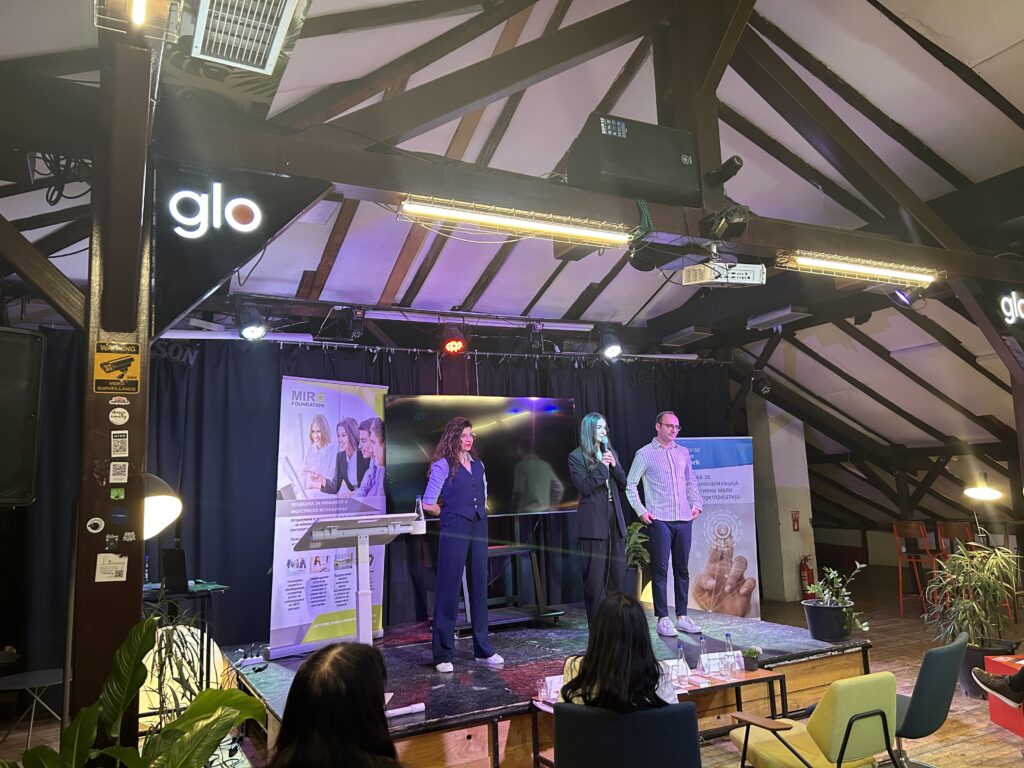
This program is part of the ST(R)E(A)M IT project, a project which aims to initiate change about the persisting gender inequalities in STEM education, research, and innovation to contribute to the implementation of the ‘The European Manifesto for gender-inclusive STE(A)M education and careers.’ The project aims to overcome the barriers and challenges faced by underrepresented groups in STEM. It focuses on developing innovative, gender- and diversity-inclusive tools for educating young people, particularly young girls. Additionally, the project seeks to mobilize stakeholders from various sectors of STEM education and the R&I ecosystem to create sustainable networks that provide ongoing support to STEM education providers.