Biopolymers in the service of orthopedics – Interview with Marija Ivanova, first-place winner of the Science communication competition
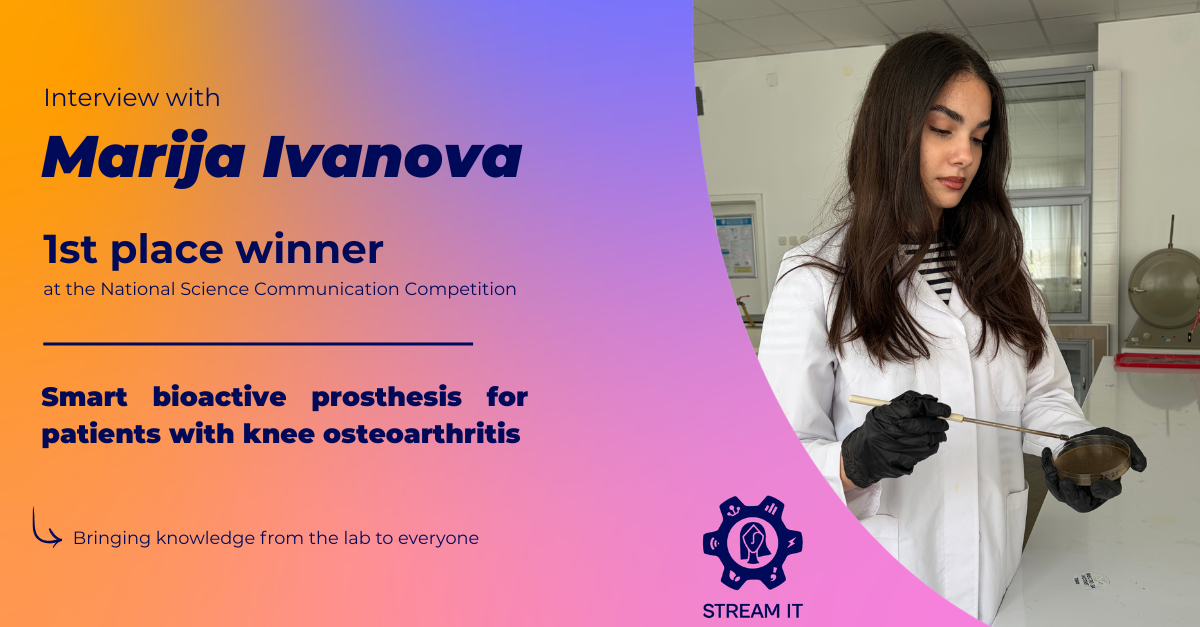
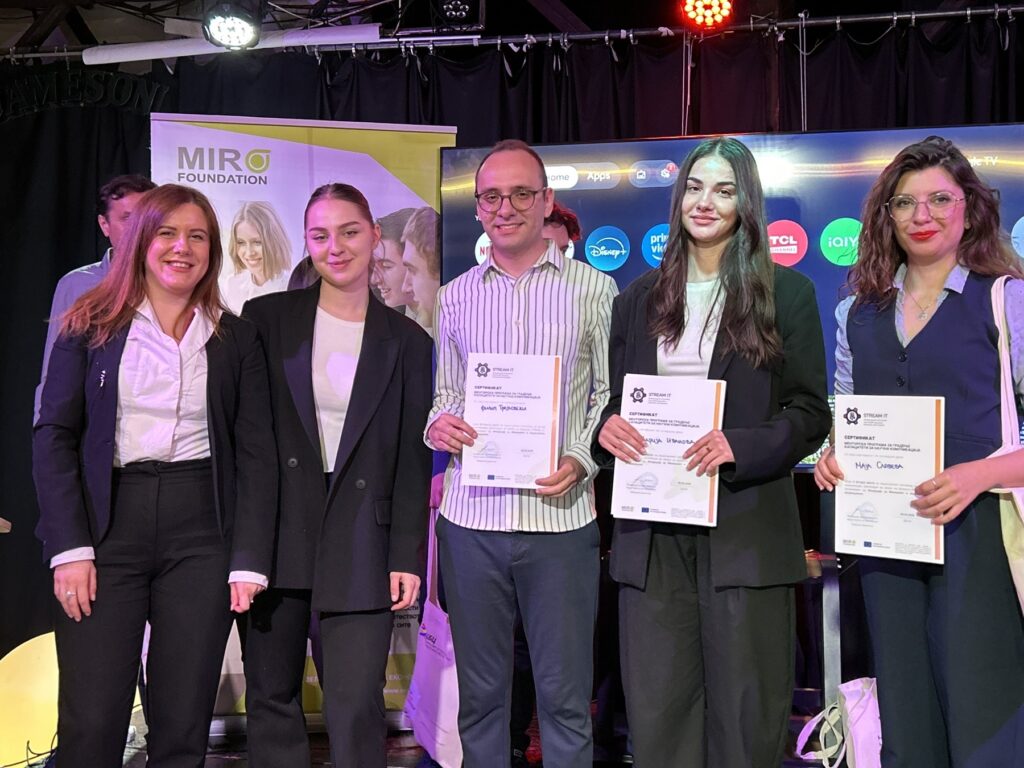
As part of the STREAM IT Mentoring Programme for science communication, a national competition was organised where young researchers had the opportunity to present their scientific ideas to a wider audience. We spoke with Marija Ivanova from the Faculty of Technology and Metallurgy in Skopje, who won first place with her presentation, “Smart bioactive prosthesis for patients with knee osteoarthritis.”
To begin with, could you tell us a little more about yourself – what did you study, and what inspired you to choose this field?
First, let me introduce myself. My name is Marija Ivanova, and I am a third-year student at the Faculty of Technology and Metallurgy at Ss. Cyril and Methodius University in Skopje, studying Biotechnology. I have always wanted to study and work with something living – a living organism – so even back in high school, when I was thinking about which university programme to choose, I knew it would be in the natural sciences. However, I chose the Faculty of Technology and Metallurgy because, while looking through the Biotechnology curriculum, I realized that this field does not only study microorganisms as living beings and explore their characteristics, but also makes them applicable on a large industrial scale. Thanks to biotechnology, today there are many biocompatible products that make everyday life easier for people.
What motivated you to apply for the mentoring programme, and what expectations did you have when you joined?
My main motivation for applying to this mentorship programme was the desire to be involved in something connected to my studies and the field I am learning about, but still outside the usual framework of lectures, exams and many laboratory exercises. For me, this mentorship programme was an opportunity to use the knowledge I had gained so far and transform it into an original idea of my own. I also wanted to connect with students from other science faculties and exchange knowledge and ideas with them.
How did the idea for the topic you presented at the competition come about, and what was the research and preparation process like?
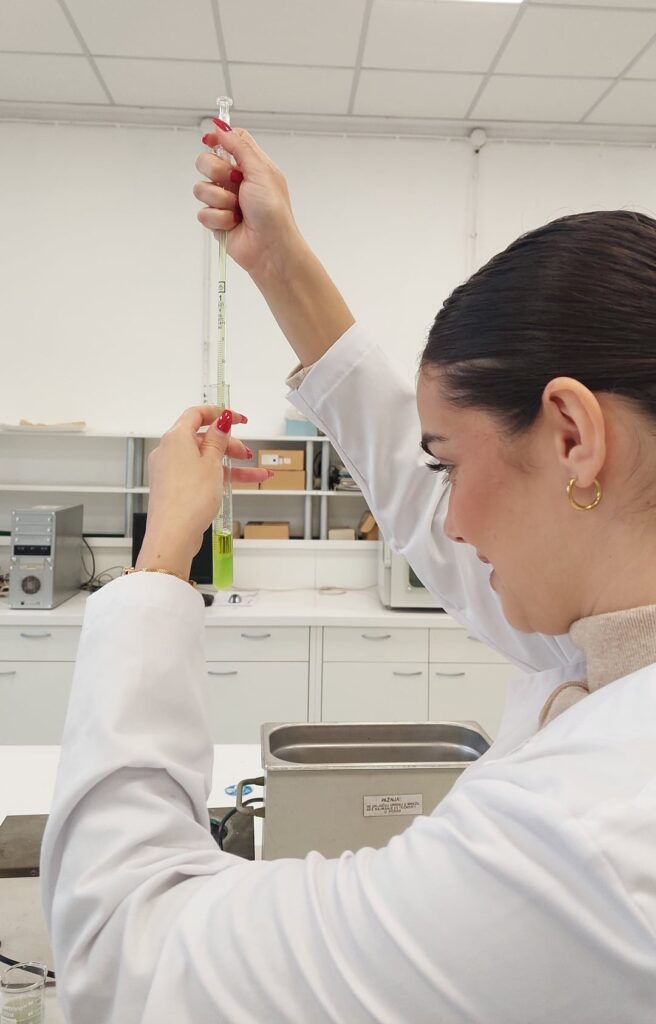
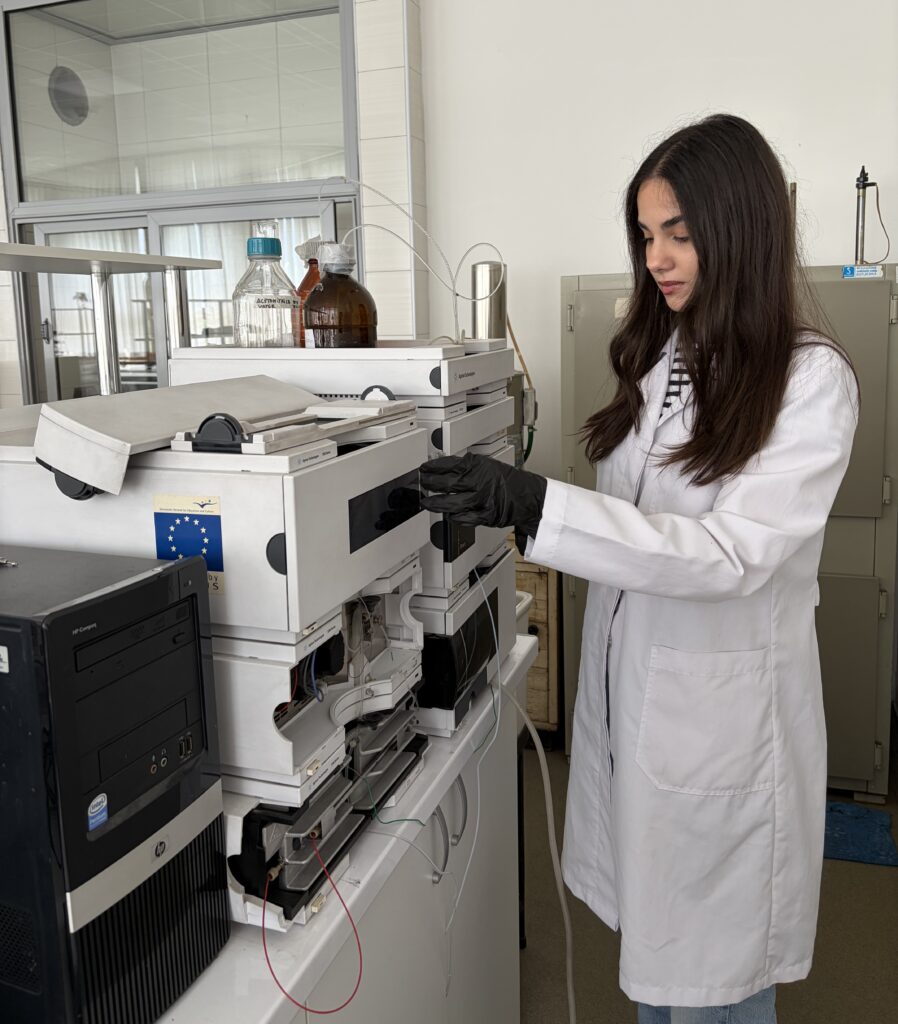
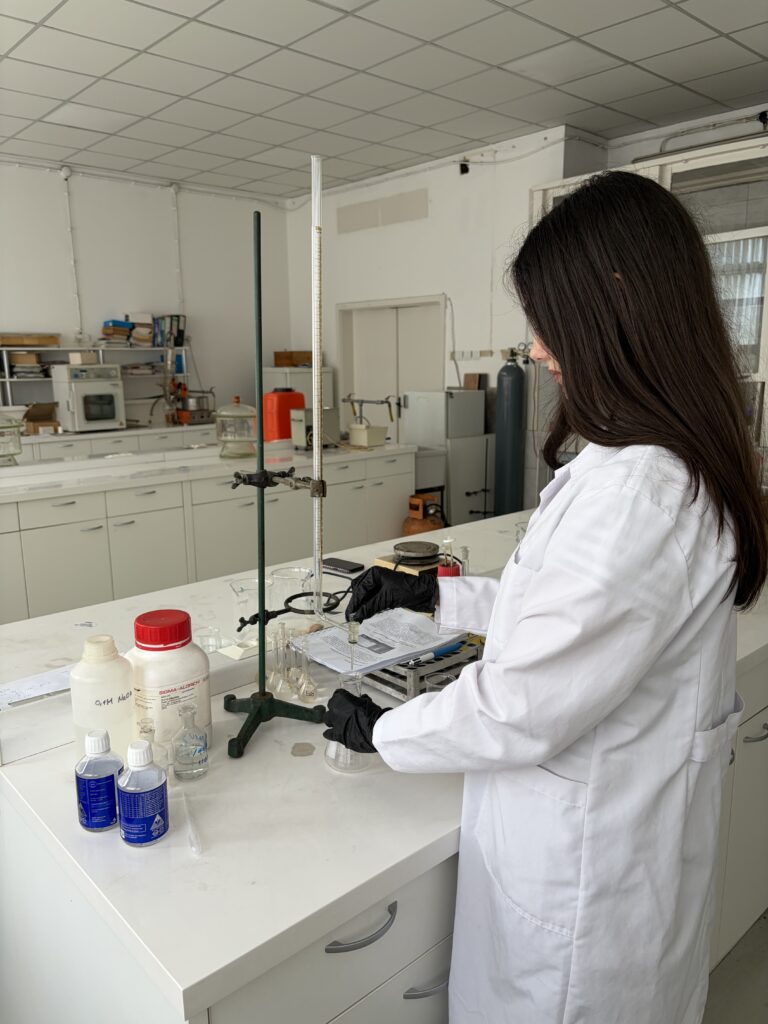
The idea to use biopolymers as the basis of my scientific research came from the knowledge I had gained in one of my university courses – Biopolymer Technology. In that course, I learned a great deal about biopolymers, their properties and the areas in which they are used, which made them ideal for incorporation into my scientific project. Biopolymers are components of our bones, joints and cartilage, and when their concentration in the body decreases, various degenerative diseases can occur. Inspired by someone close to me who was facing exactly this kind of problem, I wanted to explore how the properties of these molecules could be used to help people in similar situations. The final outcome of my research was a smart bioactive orthopaedic prosthesis intended for patients with knee osteoarthritis. The concept was based on the controlled release of biopolymers through a special mechanism built into the prosthesis.
What was the biggest challenge during the preparation process, and how much did the mentoring support help you overcome it?
I would say that the biggest challenge during the preparations was finding a way to translate certain scientific terms and mechanisms into a form that would be understandable to anyone, regardless of whether they come from a scientific background or a related faculty. Simply put, I wanted to speak in a language that would be clear to everyone who listened to the idea I was presenting.
I also wanted to improve my public speaking skills and work on my so-called “soft skills” in general. From the mentors, I received many useful tips on how to speak in front of an audience. In terms of the technical preparation for the presentation itself, through individual and group sessions, I had the opportunity to work with a dedicated mentor who generously shared her knowledge and experience in science, science communication and other relevant skills.
Was there any piece of advice, feedback, or moment from the mentoring process that particularly stayed with you?
Absolutely – and not just one. The thing that stayed with me the most happened the first time we met the mentors and the other participants. During the Bootcamp, one of the mentors was introducing herself to us, but before she told us anything about herself, she asked: “Who are the three most important people in your life?” After several participants answered her question, she shook her head and simply said: “The first person you should always mention when answering this question is actually yourself. You are the most important person in your life.”
I suppose I needed to hear that at that exact moment and learn that life lesson. By some coincidence, I later had the opportunity to have that same professor as my mentor.
Another moment I would highlight was when one of the mentors introduced us to the KISS method, which stands for “Keep It Short and Simple.” This helped me a lot while preparing for the presentation and the competition. Those words kept echoing in my mind – to be as brief and clear as possible in every part of my presentation. They helped me both with the visual design of the presentation and with writing my speech.
How did this experience influence your plans for future academic and professional development?
This experience influenced my ideas and plans for my future career by helping me realize that I do not have to limit my knowledge strictly to biotechnology as a science. Instead, I can think about how to apply that knowledge in other fields as well.
Through this experience, I learned how to improve my communication and presentation skills, and it motivated me to take part in new projects, competitions and academic activities in the future – activities that will help me grow even further, both professionally and personally.
What was the most interesting thing you learned about how science can be brought closer to the wider public?
The most interesting thing I learned is that the general public is not necessarily interested in science when it requires deep understanding of the principles and mechanisms of a specific scientific field, or when it involves reading complex scientific terms and terminology that are not part of everyday language. However, the public is very much interested in science when it is presented in a form that feels close and relevant to them – whether that is through a product, or through concrete results achieved through scientific research. In that way, the audience becomes closer to science, even if they have never had any previous contact with it.
What would you say to young people who are unsure whether to apply for programmes like this and step outside their comfort zone?
I would recommend to young people that, even if they have doubts or feel afraid to apply to programmes like this – whether because of fear of judgment or lack of self-confidence – they should simply fill out the form, share their idea and submit their application whenever they have the opportunity.
Regardless of the final outcome of the project, they will leave with a wonderful experience and newly acquired skills. Some of those skills will be directly connected to their field, while others will be useful in every other part of their professional and personal development.
This program is part of the ST(R)E(A)M IT project, a project which aims to initiate change about the persisting gender inequalities in STEM education, research, and innovation to contribute to the implementation of the ‘The European Manifesto for gender-inclusive STE(A)M education and careers.’ The project aims to overcome the barriers and challenges faced by underrepresented groups in STEM. It focuses on developing innovative, gender- and diversity-inclusive tools for educating young people, particularly young girls. Additionally, the project seeks to mobilize stakeholders from various sectors of STEM education and the R&I ecosystem to create sustainable networks that provide ongoing support to STEM education providers.