
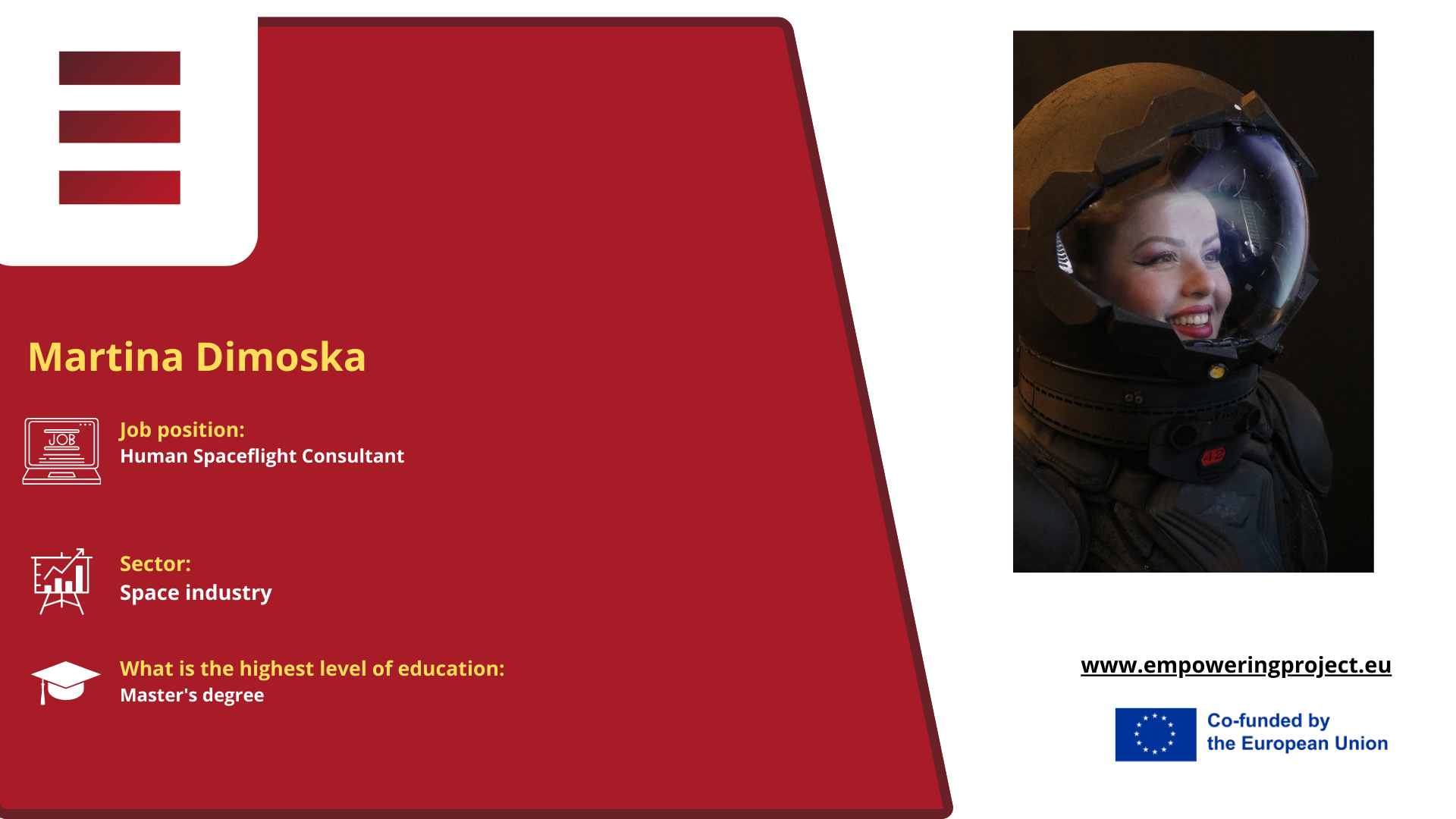
Interview with Martina Dimoska: Breaking ground in the space industry
We have created a platform for millennial women working in the industry who are ready to share their success stories. We launched a series of interviews to highlight their inspiring experiences and achievements, focusing on women who are transforming the world around them. In this edition, we spoke with Martina Dimoska, employed as a Human Spaceflight Consultant.
Can you tell us more about the company where you are working and its objective?
I work as a Human Spaceflight Consultant at Blue Abyss (United Kingdom), with presence at NASA Glenn Research Center, where I contribute to the development of concepts for human spaceflight, training in extreme environments, preparation for future commercial and research missions, international cooperation and writing and preparation of scientific grants and calls and their execution. I am also actively involved in analog astronaut missions, which simulate lunar, Martian and deep-space conditions and serve as a bridge between research and operational mission readiness.Additionally, I am the Founder and President of the International Space Alliance (ISA), an international organization operating at the intersection of the space industry, science, technology, and industry-focused education. The International Space Alliance (ISA) was founded as an initiative in Macedonia, with early activities across the Balkans. Today, ISA operates internationally, with programs and partnerships across Europe, and is formally registered both in Macedonia and in the United States, with operations based in the San Francisco Bay Area, California. Our focus is on capacity building, research collaboration, and creating practical pathways into the space sector, especially for talent coming from non-space bearing nations. My goal is to support sustainable human presence beyond Earth, while also opening access for new generations to enter an industry with exceptionally high barriers to entry.
What challenges have you faced as a millennial woman working in your industry, and how have you overcome them?
The space industry, particularly in the field of human spaceflight, has one of the highest barriers to entry. As a woman from the Balkans, I work in a space where historically there have been almost no women from the region, and even today their numbers remain extremely small, especially women who are actively engaged in industrial and operational roles, rather than exclusively in academia.
The challenges were not only technical, but structural, access to networks, trust, funding, and opportunities that are often opaque. As a young woman in leadership roles, I had to continuously build and prove credibility. I addressed this through measurable results, hands-on research and engineering experience, participation in analog missions, international exposure, and by building my own platforms and initiatives rather than waiting for permission.
I truly am ‘living the dream’, but that dream comes with constant challenging effort, high intensity of workload and responsibilities, and navigating systemic and cultural barriers. Over time, I learned that resilience, discipline, and calm decision-making under pressure are just as important as technical expertise.
What competencies or skills do you believe are most valuable for millennial women in the workplace, and why?
I believe adaptability is one of the most important skills today. The workplace evolves rapidly, especially in technology-driven industries. Millennial women are known for their independence, resilience, and creativity, which allows them to thrive in dynamic and complex environments.
In highly structured and high-risk sectors like space, they excel at translating complex problems into practical solutions, managing projects, coordinating teams, and communicating clearly under pressure. In addition, emotional intelligence, team maturity, and stability under stress are critical, as even a single weak link can impact an entire system or mission.

How can millennial women continue to develop and refine their skills in the industry?
Through hands-on experience, international projects, mentorship, and active participation in professional communities. Analog astronaut missions and industry programs are particularly valuable because they reflect real operational environments. Time, consistency, and willingness to work even when conditions are not ideal ultimately pay off.
How do you think millennial women bring a unique perspective to the industry compared to previous generations?
Our generation grew up during rapid technological and societal change, making us more flexible and value-driven, with a strong focus on inclusion, sustainability, and the importance of the human factor. In traditionally rigid and hierarchical systems, millennial women bring balance between innovation and stability, viewing work as a platform for impact and constructive change, rather than just a role.
How do you see the role of mentorship and support networks playing a part in the advancement and success of millennial women in the workplace?
Mentorship and support networks are essential for navigating invisible barriers. They provide guidance, confidence, and a sense of belonging. In my experience, they often make the difference between giving up and moving forward.
Peer support among women, and the formation of a healthy women’s community is just as important. Being a “girl’s girl” means consciously supporting other women, celebrating their achievements, and building friendships rooted in trust rather than competition. Over time, this kind of collective support strengthens communities, opens doors, and creates an environment where everyone can move forward – even when your own moment is still ahead.

Martina Dimoska
Human Spaceflight Consultant